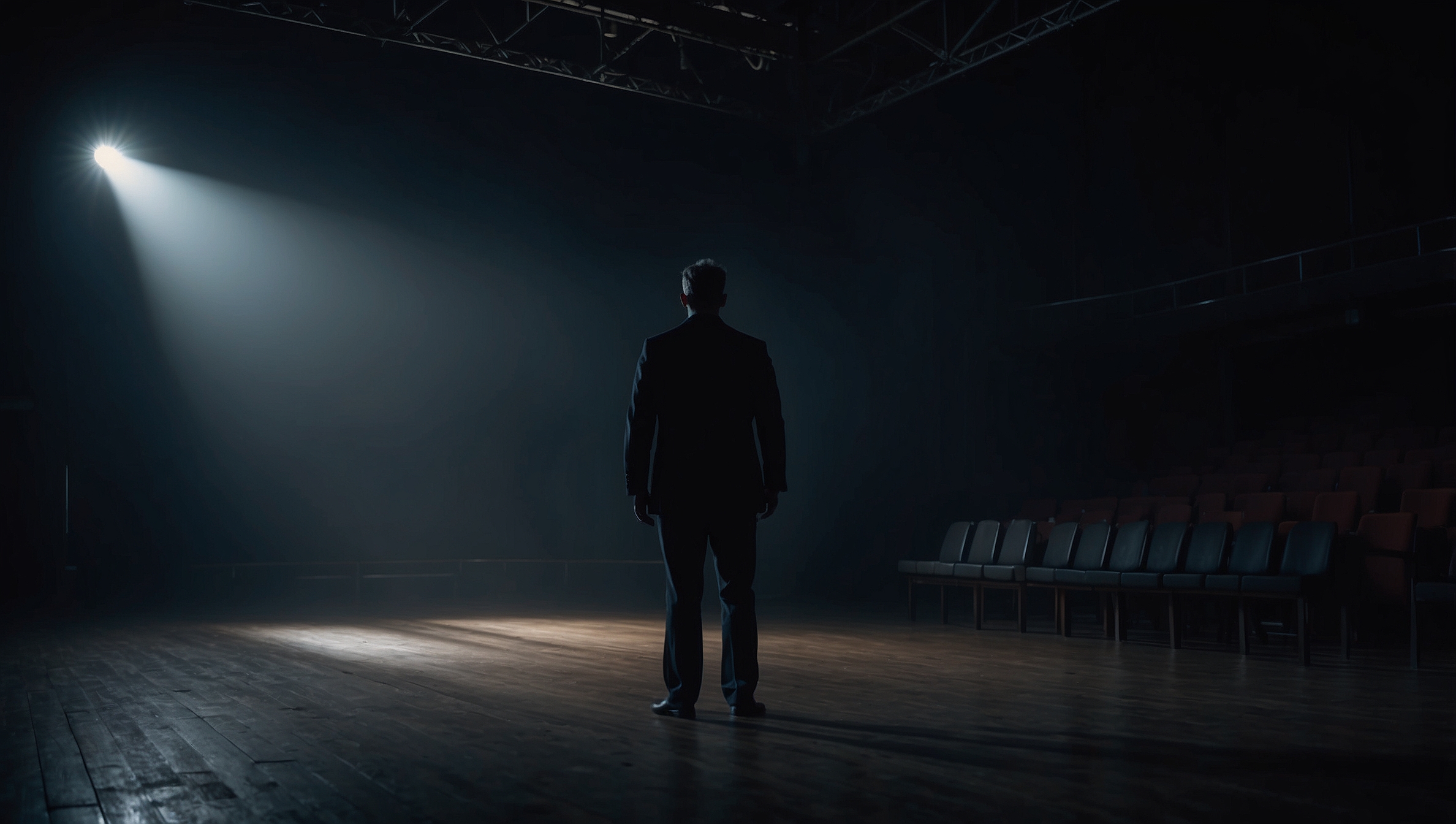
You said one slightly awkward thing in a meeting three days ago, and your brain has been replaying it on a loop ever since. You're certain everyone noticed. You're certain they're still thinking about it. Here's the strange truth: almost nobody remembers. Most of them forgot before they reached the parking lot. The audience you're performing for, the one judging your every stumble, mostly doesn't exist.
You feel watched. You feel judged. That's not vanity — it's a wiring glitch your brain runs by default, and once you can see the mechanism, it loses most of its grip.
If you keep catching yourself rehearsing conversations and bracing for judgment that never comes, there's a deeper layer worth understanding — the part of the mind that builds the imaginary audience in the first place. I've gathered the resources that helped me step out of the glare.
Explore Here →
What the Spotlight Effect Actually Is
The spotlight effect is the tendency to overestimate how much other people notice you. Psychologists Thomas Gilovich and Kenneth Savitsky gave it a name in 2000 after a now-famous experiment: they had students walk into a room wearing an embarrassing T-shirt, then asked them to guess how many people had noticed. The students guessed about half the room. The real number was a quarter — and most of those couldn't even recall which shirt it was.
The gap between how visible you feel and how visible you actually are is enormous. You live inside your own head, where you are the unavoidable main character. Every thought, sensation, and flicker of self-doubt is broadcast in high definition to an audience of one: you. So your brain quietly assumes everyone else has front-row seats too.
They don't. Everyone else is starring in their own movie, equally convinced that they're the one under the lights. The spotlight you feel on you is really just the glow of your own attention, reflected back.
Why Your Brain Builds an Invisible Audience
This isn't a character flaw. It's a side effect of being conscious. You can never step outside your own perspective, which means you can never fully grasp how little of you reaches anyone else. The technical name for this trap is "anchoring" — you anchor on your own intense self-awareness and fail to adjust enough for the fact that other people simply aren't paying that much attention.
There's also an evolutionary thread here. For most of human history, social standing was survival. Being judged, shamed, or cast out of the tribe could be a death sentence. So your nervous system evolved a hypersensitive alarm for social threat — a system that would rather flood you with false alarms than miss a real one. That ancient circuitry is still running, except now it fires over a typo in an email or the way your voice cracked on a call.
The result is a brain that treats every minor social moment like it's being recorded, broadcast, and archived. It isn't. But the feeling is so vivid that you mistake it for fact.
The loop feels permanent, but it isn't. The same attention that built the cage can dismantle it — once you learn to point it somewhere new. These are the tools that helped me retrain where my focus goes.
Explore Here →
The Hidden Cost of Living Under Imaginary Lights
The spotlight effect would be harmless if it just made you a little self-conscious. But left unchecked, it quietly runs your life. You skip the dance class because you imagine everyone clocking how stiff you are. You stay silent in the meeting because you're sure your question will sound stupid. You rehearse conversations for hours and replay them for days. You shrink your life to fit the dimensions of an audience that was never really there.
Notice what's happening: you're paying a real, daily tax to satisfy an imaginary crowd. Every avoided opportunity, every unspoken idea, every joy declined "because people might look" — that's the cost. And the cruelest part is that the crowd doesn't even collect it. They never noticed your absence. You paid for nothing.
This is also where chronic social anxiety takes root. The more you monitor yourself for flaws, the more self-focused you become, and the more convinced you are that your flaws are on display. It's a closed loop: attention inward generates the very feeling of being watched, which pulls attention further inward.

The Reality Check That Sets You Free
Here's a thought experiment that dissolves the spotlight fast. Think about a stranger you saw yesterday — someone who tripped, fumbled their words, or wore something odd. Can you picture them? Almost certainly not. You weren't judging them. You barely registered them, because you were busy being the main character of your own day.
Now flip it. That's exactly how other people experienced you. The mistake you're still cringing over landed in someone else's awareness for maybe two seconds before their brain moved on to their own worries — their deadline, their relationship, their own imagined spotlight. People are not thinking about you, because they're too busy worrying that you're thinking about them.
This is sometimes called the "everyone is the center of their own universe" principle, and it's oddly liberating. The indifference you fear is actually a gift. Nobody has the bandwidth to scrutinize you, because scrutinizing themselves already consumes all of it. You are free precisely because you are not as important to strangers as your brain insists you are. Once you really absorb this, the air changes. The stakes deflate. You realize you've been auditioning for an empty theater.

How to Switch the Spotlight Off
Knowing the spotlight effect exists isn't enough to escape it — the feeling is faster than the fact. But you can train a different default. The core move is shifting attention from inward monitoring to outward engagement. When you're genuinely curious about the person in front of you, focused on the task, or absorbed in the moment, there's simply no spare attention left to feel watched. Self-consciousness and engagement can't occupy the same mind at once.
A practical drill: next time you feel the spotlight flare, name it silently. "That's the spotlight effect." Naming it creates a sliver of distance between you and the feeling, and in that gap you get to choose your response instead of obeying the alarm. Then deliberately redirect your focus outward — onto what someone is saying, onto the sensation of your feet on the floor, onto anything that isn't your own performance.
Another reframe that helps: assume nobody noticed, and act accordingly. Send the message. Ask the question. Wear the thing. The evidence will accumulate — each time the feared judgment fails to arrive, your nervous system updates a little. You're not suppressing the fear; you're disproving it through experience, which is the only thing the body actually believes. And remember that the people whose opinions genuinely matter to you aren't keeping score of your stumbles. They're rooting for you.
What Happens When the Lights Go Down
The goal isn't to stop caring about people entirely — connection still matters, and a little social awareness keeps you kind. The goal is accuracy. You want your sense of being watched to match the actual, modest amount that you are. When that calibration happens, something quietly profound shifts: you get your attention back.
All that energy you spent managing an invisible audience becomes available for the things that are real — the conversation actually in front of you, the work you care about, the version of yourself you want to build when you forget to perform. You stop editing your life for reviewers who left the theater long ago.
The spotlight effect never fully disappears, because the brain that produces it is the same brain you'll always live inside. But it loosens. You learn to recognize the glare for what it is — your own attention, not the world's. And recognizing it is most of the cure. So the next time you feel the heat of imagined eyes, remember the empty stage. The seats are vacant. The lights are coming from inside your own head. And you, finally, get to decide whether to keep performing — or simply step down into your life and live it.
If no one is really watching, who would you be brave enough to become?
The audience was never there. The freedom always was. If you're ready to retrain the mind that builds the spotlight — and quiet the part of you that keeps bracing for judgment — this is where I'd start.
Explore Here →